New Sahel anti-terror force: risks and opportunities
Burkina Faso, Chad, Mali, Mauritania, and Niger are teaming up to
take on Islamist militants with the launch of a the 5,000-strong
"FC-G5S" force in the restive Sahel. But are more boots on the ground
the answer?
UN Secretary-General António Guterres recently told
the Security Council, which votes today on whether to fund the nascent
multinational military force, that supporting it was “an opportunity
that cannot be missed” and that failing to back it would carry serious
risks for a region where insecurity has become “extremely worrying”.
The Security Council “welcomed the deployment” of the force in a resolution
adopted in June, but put off a decision about financing. The
resolution's wording was the subject of a prolonged tussle between
France – the G5 force’s main proponent – and the United States, which didn’t believe a resolution was necessary,
sees the force’s mandate as too broad, and, as the world body’s biggest
contributor, isn’t convinced the UN should bankroll it.
On Friday, US Ambassador to the UN Nikki Haley said Washington wants
to know “what the strategy would be, how they see this playing out,
what’s involved in it, before we ever commit to UN-assessed funding”.
France has been working hard to win over the United States. On a
visit to Washington last week, French Defence Minister Florence Parly
said the former colonial power had no desire to become the “Praetorian
Guard of sovereign African countries”. Existing forces
In 2013 and 2014, France’s Operation Serval drove back militants in
Mali’s northern desert from some of the towns and other sanctuaries they
had taken. With attacks nevertheless continuing and having spread
beyond Mali’s borders, 4,000 French troops are currently deployed under
the banner of Operation Barkhane across all the G5 states.
Mali is also home to the 14,000-strong MINUSMA force, one of the UN’s
most expensive peacekeeping missions. It has come under frequent attack
by militant groups such as the Jama'a Nusrat ul-Islam wa al-Muslimin
(JNIM), an al-Qaeda-linked coalition forged last March. Some 86 blue
helmets have been killed in militant attacks since MINUSMA was
established in July 2013.
Meanwhile, efforts by civil society groups to negotiate with some jihadist groups have come to nought, while parties to a 2015 peace agreement
between Mali’s government and two coalitions of domestic armed groups –
a deal that excluded the jihadists – are embroiled in violent divisions
among themselves. Some of these domestic groups are also responsible
for attacks against the state.
These divisions have dimmed hopes of forging any kind of common front
against the jihadists, and even of properly implementing the 2015
accord. The government’s failure to address widespread political and economic grievance further undermines its position.
Sylvain Liechti/UN Photo
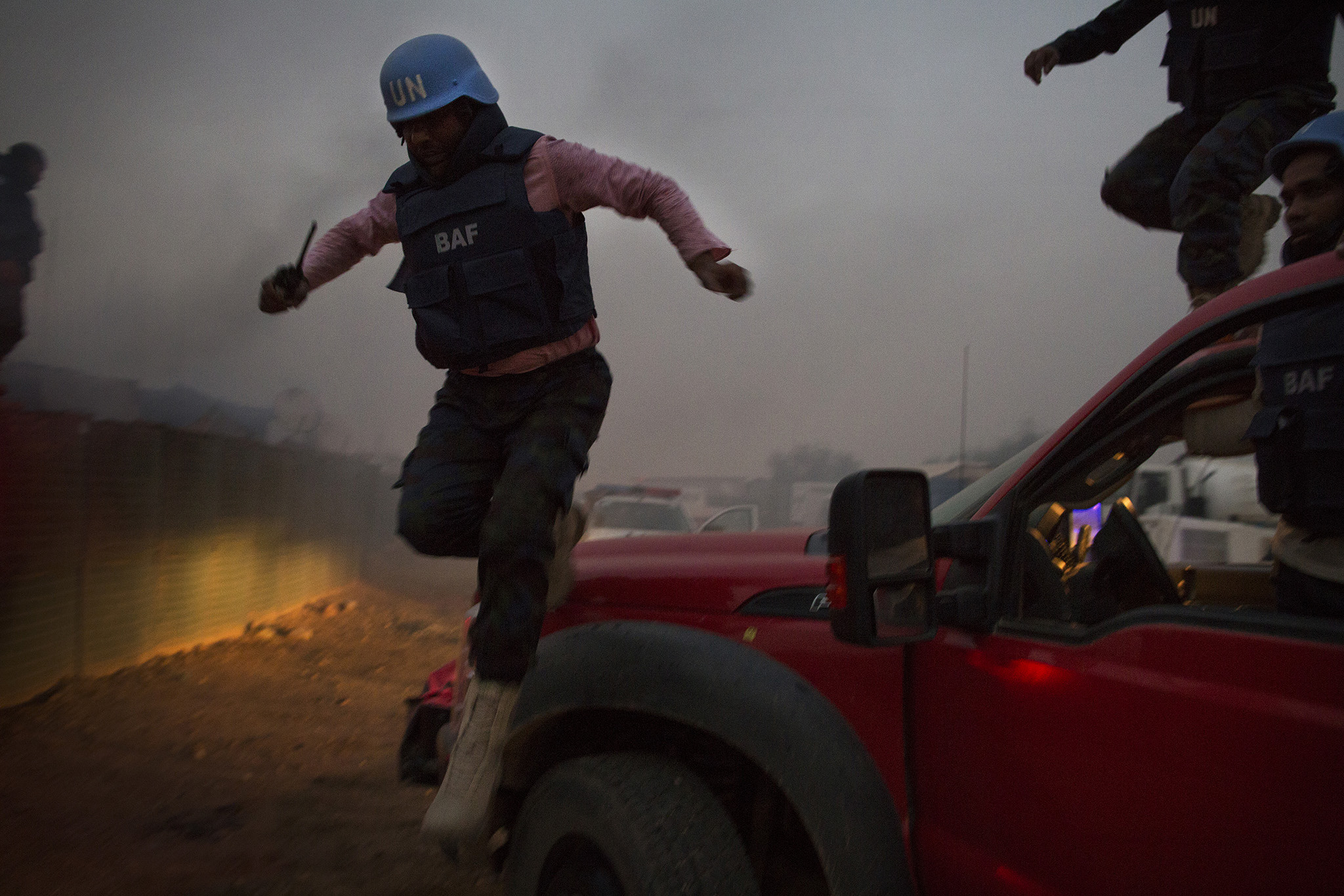
The MINUSMA Camp in Kidal was targeted by intensive rocket and mortar fire
Humanitarian fallout
All this insecurity comes at a high price for Mali’s civilians. At
the end of the 2016-17 academic year, 500 schools were closed, up from
296 the previous year, while the numbers of refugees and internally
displaced reached a record 140,000 and 55,000 respectively.
Acute malnutrition among children under five has reached “critical
levels” in conflict-affected areas around Timbuktu and Gao, according to
UNICEF. The agency predicts that 165,000 children across the country
will be acutely malnourished next year.
“Repeated criminal acts” prompted the International Committee of the
Red Cross to suspend its operations in the northern Kidal region in
mid-October.
Funding concerns
The primary mandate of the G5 force will be to secure the bloc’s common borders and fight “terrorist” and criminal groups.
The force’s headquarters were established in September in the central
Malian town of Sévaré, but its financing has yet to be secured.
“Estimates still vary; nothing has been settled,” said a diplomat who
has followed the latest developments. “If we get to 250 million euros
at the donors’ conference in December, that would be very good. But even
if financing is obtained in December, the force will not be operational
the next day.”
The G5 says it needs 423 million euros to set things up and run the
force for its first year, but so far only a quarter of this sum has
materialised, with the G5 and the EU both coming up with 50 million
euros and France another eight million.
"Mobilising sustainable and consistent financial support over a
period of several years will remain a significant challenge,” conceded
Guterres in his report.
Money is far from the only uncertainty: Trust between G5 member states remains shaky.
“The Burkina military believe their Malian counterparts are ‘lazy’
and joined the army to get an income and not to defend the country,” the
International Crisis Group said, for example, in its latest report on Burkina Faso.
And the security and political agendas of G5 states are not always
aligned. Facing an economic and social crisis, regional powerhouse Chad,
which already has troops in MINUSMA and in a separate regional force
fighting Boko Haram, hopes to make the most of its involvement in the
force, whose remit it would like to see expanded to include other
regional threats closer to home.
Risks
Given how often existing forces in Mali, including the army, are
attacked (losing weapons and vehicles in the process), deploying yet
more troops in the region carries a real risk of further boosting
jihadists groups’ military assets.
“Malian armed movements have employed an increasing proportion of
heavy weaponry from Malian government stockpiles – particularly
ammunition for larger weapon systems such as rockets and artillery – as
opposed to Libyan or other foreign sources,” Conflict Armament Research
said in a 2016 report on the Sahel.
Human Rights Watch recently reported on “killings, forced
disappearances and acts of torture” committed by security forces in Mali
and Burkina Faso against suspected members of jihadists groups.
Even if they are only committed by a minority of soldiers, such acts
lead civilians to mistrust the armies supposed to protect them, and in
some cases to join the armed groups to seek their protection instead.
“The fighters are found among the greater population, are part of
them and live with them. It is not easy to identify them. That makes
combat difficult, even if there are far fewer jihadist than soldiers,”
explained Ibrahim Maîga, a researcher with the Institute for Security
Studies.
“You can’t defeat these people without helping the population caught
in the middle. One side accuses them of being terrorists, the other of
collaborating with national or foreign armies. This is why it is
imperative that the state gains more legitimacy,” he added.
The G5 joint force’s first operations are expected to take place in
the Liptako-Gourma region, where the borders of Mali, Niger, and Burkina
Faso meet. These states have been particularly affected by the attacks
carried out by JNIM, Islamic State in the Greater Sahara, and Ansarul Islam against national and foreign security forces.
On 21 October, 13 gendarmes were killed when their barracks in Ayorou in Niger’s Tillaberi region came under attack.
The joint force will be deployed in an environment rife with
trafficking of all kinds, and with globalised jihad, and where myriad
local conflicts merge with and fuel each other.
On the border between Mali and Niger, economic rivalry between Tuareg
and Fulani communities has deepened since becoming militarised and
politicised.
Fulani youth – too simplistically – are seen as ready recruits to jihadist groups, and Nigerien Tuareg militia are being used by the government to hunt them.
In northern Burkina Faso, Ansarul Islam built its popularity by
challenging social structures widely seen as inequitable, according to
the ICG.
Harandane Dicko/MINUSMA
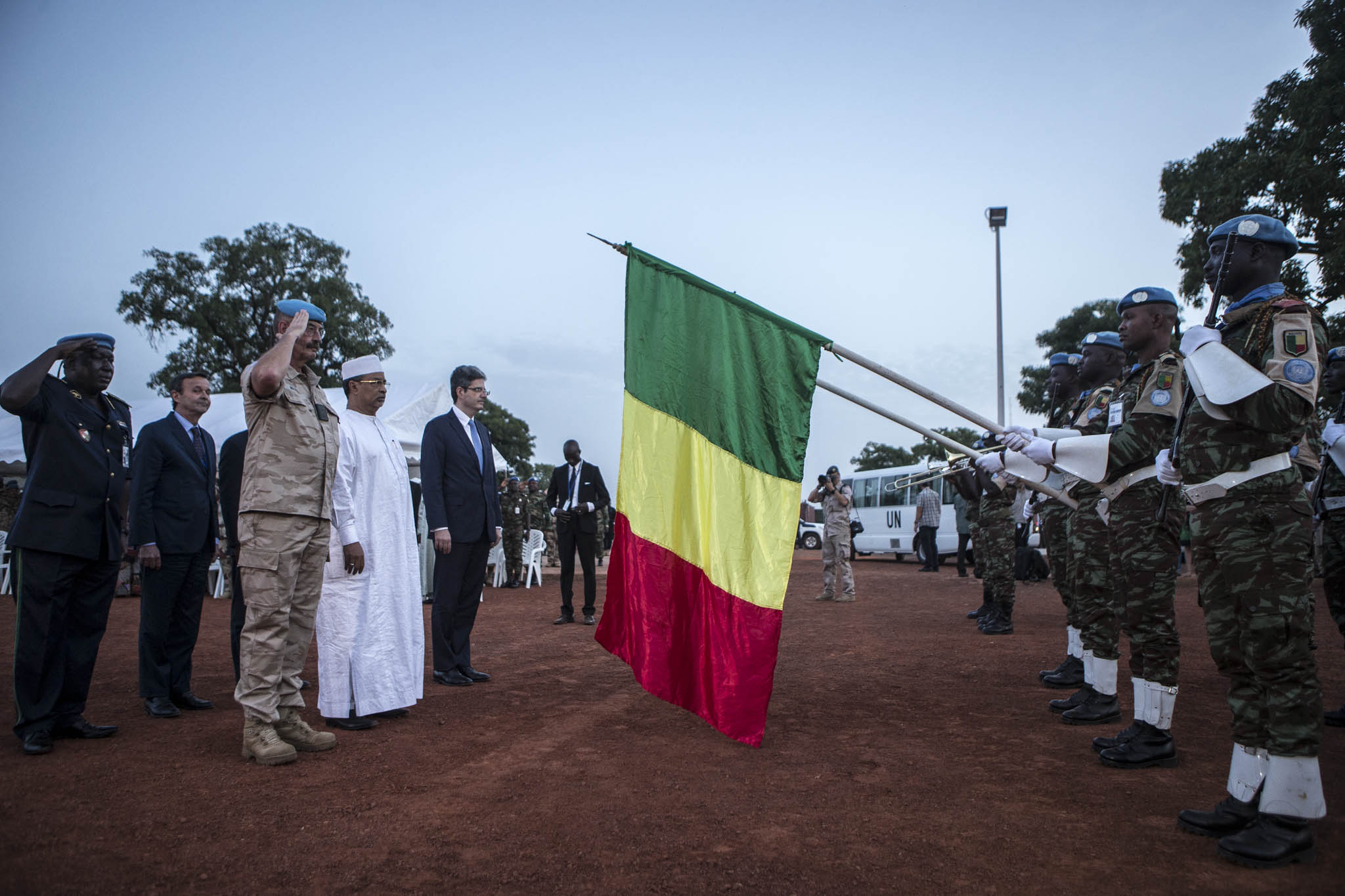
Security Council ambassadors pay their respects to UN peacekeepers killed in the line of duty
US role
None of the groups operating in the region has claimed responsibility
for the 2 October attack in which four US and four Nigerien soliders
were killed 200 kilometres north of Niamey – an attack a top US general has attributed
to a local IS-affiliated group. The incident served to bring
international attention to US military presence in the region, described
by some media as a “shadow war” at a time when the US is in the process of moving its drone operations from Niamey to the central Niger town of Agadez.
“Our American colleagues believe the [Niger] attack against their
troops exposes a dilemma: Do too much and be exposed, or don’t do
enough,” a French diplomat remarked.
It seems the Pentagon is going for the first option: US Defense
Secretary James Mattis recently informed Congress that the United States
was increasing its anti-terrorism activities in Africa and that new
rules of engagement were being introduced, allowing troops to open fire
on mere suspects.
But for the jihadist groups in the region, a greater US military
footprint will feed their rhetoric of occupation and help swell their
ranks.



Comments
Post a Comment